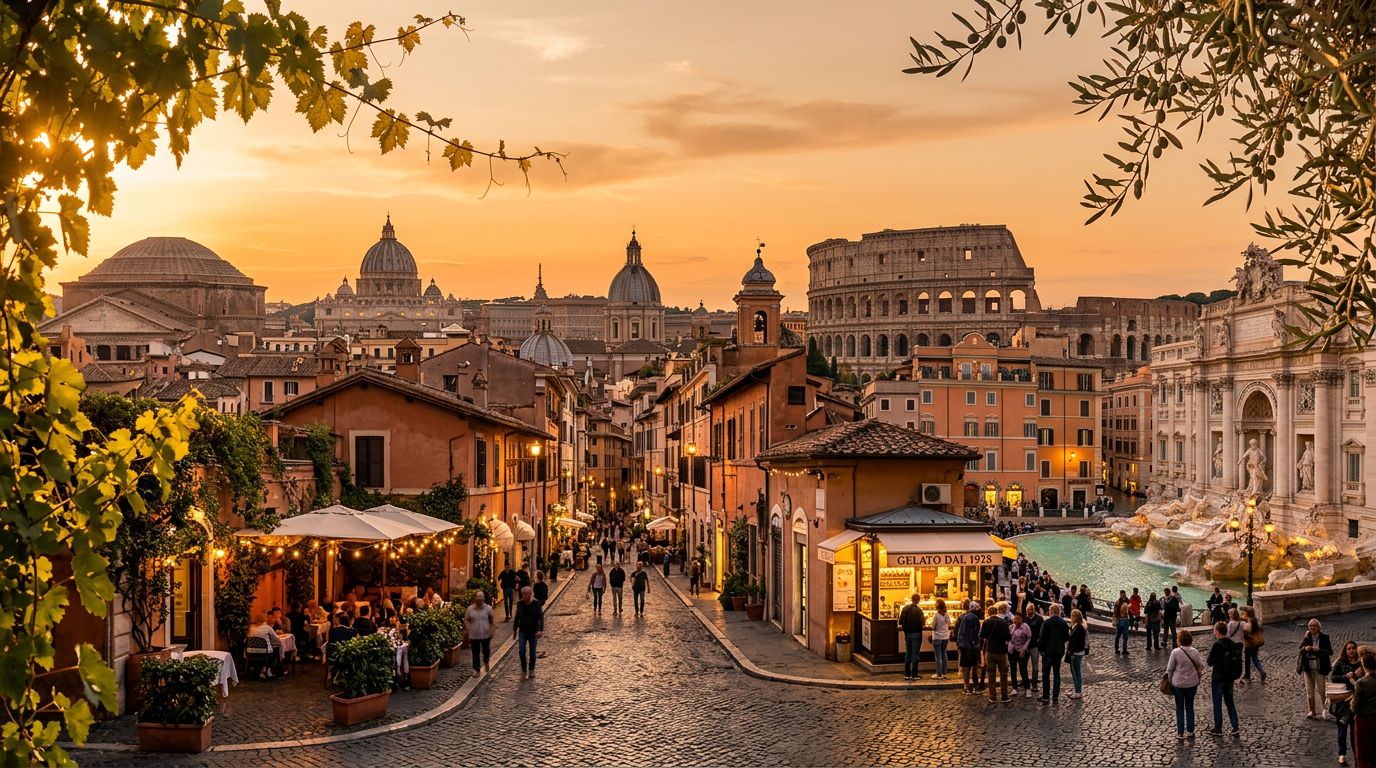


Rome will absolutely charm you, feed you, and wreck your step count before lunch.
If you are trying to plan a 4 day Rome itinerary without ping-ponging across the city like a confused tourist with one dead phone battery, the trick is simple: group your days by area, book the big-ticket sights early, and leave a little room for long lunches and accidental gelato. From the iconic history of ancient Rome and the grandeur of the Colosseum to the splashing waters of the Trevi Fountain and the charming evening atmosphere in Trastevere, this trip has it all.
This itinerary is built for first-time visitors who want the classics, a few less-obvious stops, and a pace that still feels like a vacation.
Key Takeaways
- Group by Geography: To avoid exhaustion and wasted transit time, plan your daily activities by neighborhood rather than bouncing across the city.
- Book in Advance: Essential landmarks like the Colosseum, Roman Forum, Pantheon, and Vatican Museums require pre-booked, skip-the-line tickets to avoid hours of waiting.
- Balance the Pace: Intersperse high-energy sightseeing with slower afternoon activities or relaxed neighborhood strolls to keep the trip enjoyable rather than grueling.
- Embrace Early Mornings: Iconic spots such as the Trevi Fountain and the Vatican are best experienced shortly after opening to avoid the worst of the mid-day tourist crowds.
- Dress Appropriately: Keep clothing that covers your shoulders and knees handy, as Roman basilicas enforce strict dress codes.
Where to Stay in Rome Without Making Life Harder
For a first trip, where you stay matters almost as much as what you see. Rome is walkable in bursts, not in a way where you can casually stroll everywhere with zero planning. Pick a neighborhood that matches your travel style, and the whole trip becomes significantly easier to manage.
If you are torn between areas, this local guide to where to stay in Rome is a helpful gut check before you book.
Monti for the easiest sightseeing base
Monti is the sweet spot for a first visit. You are within walking distance of the Roman Forum and Termini Station, but the neighborhood still feels authentic and lived-in. Think cobbled lanes, wine bars, little boutiques, and enough atmosphere to make you feel confident in your hotel choice.
Condominio Monti is a great pick if you want style and a rooftop without feeling stuck in a big chain hotel. Nerva Boutique Hotel works well for couples who want something polished and quiet near Ancient Rome. Hotel Grifo is a smart value option if location matters more than extra bells and whistles.
The trade-off is noise. Some streets stay lively late, and Monti has a few sneaky hills to keep in mind.
Prati for a calmer, cleaner-feeling stay
If you prefer wider streets, easier luggage dragging, and evenings that do not sound like a bar crawl outside your window, Prati is a solid call. It is near the Vatican and well connected by metro, which makes it a great fit for families, solo travelers, and anyone who prefers a little breathing room compared to the bustling Centro Storico. Being located here also makes visiting the Vatican Museums much more convenient early in the morning.
Hotel Della Conciliazione puts you close to St. Peter’s without dropping you into peak tourist chaos. Trianon Borgo Pio Aparthotel is especially good for families or longer stays because having extra space in Rome feels like winning the lottery. Hotel Silla is a simple, practical choice if you want to keep the budget from spiraling.
Prati is less overtly romantic than Monti or Trastevere, but it makes daily sightseeing ridiculously easy.
Trastevere and Testaccio for food people
If dinner is one of your main hobbies, stay on this side of the river. Trastevere is charming, lively, and full of ivy-covered corners that look like a movie set. Testaccio feels more local and less polished, offering authentic food scenes and far fewer selfie sticks per square foot.
Hotel Santa Maria is tucked into a peaceful pocket of Trastevere and feels surprisingly serene. Horti 14 Borgo Trastevere works well if you want a stylish stay with easy access to the neighborhood’s many restaurants. In Testaccio, Seven Suites is a good choice for travelers who care more about local energy than postcard views.
The catch is transport. Metro access is not as handy here, and Trastevere can get quite loud at night.
Quick Planning Tips for a Smoother Rome Itinerary
If you are building a 4-day Rome itinerary, do not treat the city like a simple checklist. It is much more enjoyable when each day has a clear geographic zone, one primary goal, and enough space for a long, slow meal.
Rome looks compact on a map. However, once the cobblestones appear and your espresso kicks in, you might find you have walked six miles before it is even time for aperitivo.
Plan on walking about 5 to 8 miles per day. Day 1 and Day 2 are typically the busiest. Day 4 offers more flexibility, especially if you decide to swap in a day trip to Ostia Antica or spend extra time in a museum.
Use the metro when it saves time, particularly for stops like Colosseo, Ottaviano, and Circo Massimo. Buses fill in the gaps, but walking is often faster in the historic center. From Fiumicino Airport, the Leonardo Express to Termini is usually the most efficient arrival move. If you take a taxi, use an official white cab and confirm the posted flat fare before you depart.
Strategic booking is essential for a stress-free trip. You should book skip-the-line tickets for the Colosseum, the Roman Forum, and the Vatican Museums well before you travel. These sites are the ones most likely to punish procrastination. If you prefer a deeper dive into the history, booking a guided tour can make your visit to St. Peter’s Basilica or the major ruins much more insightful. Keep in mind that iconic landmarks like the Trevi Fountain and the Spanish Steps are best visited early in the morning to avoid the largest crowds. When visiting churches, carry clothing that covers your shoulders and knees. Rome is relaxed about many things, but basilica dress codes are not one of them.
Spring and fall are the easiest seasons for this itinerary. Summer is beautiful, but sightseeing in the mid-afternoon can feel like standing inside a pizza oven.
Day 1: Ancient Rome, Then a Soft Landing in Monti
Start with the Colosseum before the city wakes up
Begin your exploration of ancient Rome at the Colosseum with the earliest timed entry you can get. It is one of those places that can feel overhyped until you are standing there, staring at a giant stone arena that somehow still looks dramatic after two thousand years.
Go straight on to the Roman Forum and Palatine Hill. Keep your expectations realistic, as this area is huge, sunny, and packed with history that can blur together fast if you are hungry or under-caffeinated. If you love context, booking a guided tour of the Colosseum and Roman Forum pays off by bringing these massive structures to life.
By late morning, you will be ready for shade and food.
Spend the afternoon around the Forum and nearby churches
Have lunch in Monti, rather than eating right outside the Colosseum where menus start waving at you from across the street. Monti has better options and a much nicer pace. After lunch, walk to San Pietro in Vincoli to see Michelangelo’s Moses. It is quick, memorable, and easy to add without wrecking the flow of the day.
If you still have energy, head toward Capitoline Hill for one of the best views over the area. It feels dramatic without requiring another giant time commitment, which is exactly the kind of win you want on day one.
This is a good afternoon to keep intentionally light. Your brain is processing centuries, your feet are negotiating with you, and Rome is not going anywhere.
End with dinner and a wander through Monti
Monti is perfect for your first Rome evening because it feels lively without being overwhelming. Walk Via dei Serpenti, grab an aperitivo around Piazza della Madonna dei Monti, and let yourself adjust to the city rhythm.
For dinner, go classic. Whether you choose carbonara, cacio e pepe, or amatriciana, you are in for a treat. While many tourists head straight for the crowded streets of Trastevere, staying local in this neighborhood provides a more relaxed introduction to the city. You are in Rome now, and sad desk salads are not invited.
If you want one last look before bed, stroll toward the Colosseum after dark. It glows at night, and the whole area feels calmer once the daytime crowds thin out.
Day 2: Vatican City, the Historic Center, and Rome’s Greatest Hits
Tackle the Vatican early, before it turns into a theme park line
If the Vatican Museums are on your must-do list, arrive at opening time to give yourself the best chance of seeing the galleries before the shoulder-to-shoulder shuffle begins. Booking skip-the-line tickets in advance is essential to saving precious time. As you navigate the halls, the highlight is undoubtedly the Sistine Chapel, so make sure to pace yourself while admiring the ceiling. If you prefer to focus on architecture, start at St. Peter’s Basilica instead and climb the dome while your legs still trust you.
Inside St. Peter’s Basilica, the sheer scale of the interior is wild. Everything looks close until you start walking and realize the church is basically its own zip code. After admiring the art, take a moment to visit the Sistine Chapel again if you missed it earlier, or simply reflect on the history contained within the Vatican Museums. When you finish, step out into the square and take a breath. A Vatican morning is big, busy, and worth doing early for that reason alone.

Photo by Vladimir Gladkov
Cross the river and hit Rome’s iconic center on foot
From the Vatican, walk toward Castel Sant’Angelo. Even if you do not go inside, the route along the bridge is a classic Rome moment that earns the hype.
From there, continue into the Centro Storico. Piazza Navona comes first, followed by a visit to the Pantheon. Both sites are iconic, but remember that the Pantheon requires a pre-booked entry slot during busy periods. Take a break for coffee or gelato before continuing your walk. This is a high-reward route because every ten minutes the city throws another beautiful square, like Piazza Navona, at you as if it is showing off. Before heading toward your final stops, you might even wander toward the expansive Piazza del Popolo to see one of the city’s most impressive gates.
Save Trevi Fountain and the Spanish Steps for later in the day
See the Trevi Fountain in the late afternoon or after dinner. Midday at the Trevi Fountain feels like the whole internet showed up at once. By evening, it is still busy, but the light is better and the mood is less frantic.
From there, walk to the Spanish Steps. This is one of those stretches where Rome feels exactly like the version people imagine before they arrive, filled with polished storefronts and dramatic architecture. The Spanish Steps remain a perfect place to people-watch as the sun sets. Keep an eye on your energy here. Day 2 can turn into a monster if you try to cram in every famous site within a single mile. You do not need to win Rome; you just need to enjoy it.
Day 3: Aventine Hill, Testaccio, and a Better Kind of Rome Day
Begin with a quieter side of the city
After two big sightseeing days, this is where you let Rome loosen its shoulders. Start on Aventine Hill with the Orange Garden. The view is lovely, the vibe is calm, and it feels miles away from the noise even though it is not far from the center.
A few minutes away, peek through the Aventine keyhole. It is quick, silly, famous, and still weirdly satisfying. Then walk down toward Circus Maximus for a broad view of a part of ancient Rome that once held chariot races. From this vantage point, you can even catch a glimpse of the Roman Forum in the distance.
This morning has space in it, which is the whole point.
Head to Testaccio for lunch and one smart museum stop
Make your way to Testaccio for lunch. This neighborhood is one of the best places in Rome to eat without feeling like you are in a theatrical performance for tourists. Testaccio Market is great for a casual lunch, especially if everyone in your group wants something different.
In the afternoon, choose one nearby stop. Centrale Montemartini is a fantastic pick if you want a museum that feels fresh. Ancient sculptures inside an old power plant sounds like a fever dream, but it works. The Non-Catholic Cemetery, near the Pyramid of Cestius, is another peaceful option if you want something thoughtful and low-key.
If local-food neighborhoods matter to you, this Rome discussion on quieter areas with better local dining gives a pretty honest picture.
Finish in Trastevere with dinner and a sunset view
Cross into the city center toward the Jewish Ghetto before heading across the river to Trastevere for the evening. Wander first, eat later. That is the move here. Grab a scoop of gelato to enjoy while you walk, as this neighborhood is at its best when you let yourself drift a little.
For sunset, climb to the Gianicolo terrace. It is one of the easiest scenic payoffs in the city, especially for couples, but it does not feel too cheesy for solo travelers or families either.
Then go back down for dinner in Trastevere. Keep expectations realistic, because not every ivy-covered trattoria is a life-changing meal. Still, when Trastevere gets it right, it really gets it right.
Day 4: Appian Way, Catacombs, and Ruins With Breathing Room
Use your last day for a different kind of Roman history
By day four, you have earned a break from the most crowded parts of the center. The Appian Way is perfect for that. You can walk or bike sections of this ancient road to see a side of Rome that feels older, quieter, and a little eerie in the best way.
Pair the Appian Way with a visit to one of the catacombs if that sounds interesting to you. Booking a guided tour of these subterranean burial sites provides fascinating context, and it adds a welcome contrast to the trip that avoids the long lines found near popular fountains. If you want a more structured experience, a professional guided tour through the catacombs is a great way to ensure you do not miss the hidden historical details.
If you like the idea of Rome without the crush, this roundup of non-touristy things to do in Rome has a few more smart ideas.
Spend the afternoon at the Baths of Caracalla
After visiting the Appian Way, head to the Baths of Caracalla. Located not far from the Colosseum, these ruins are massive, atmospheric, and usually less crowded than the Forum. They also do something rare in Rome, as they give you plenty of space to roam.
That is the charm of this final day. You are still seeing major history, but without feeling packed into the city’s busiest corridors. If you have kids or teens with you, the sheer scale of these ruins often lands better than another room full of marble busts.
If the weather is bad, this is the easiest day to swap. Ostia Antica is another excellent ruin site if you want a half day trip, while Centrale Montemartini or the Capitoline Museums work well indoors.
End with one last Roman dinner, then walk it off
For your final evening, do not overcomplicate things. Go somewhere you actually want to linger. Testaccio is perfect for one last proper meal, while the historic center is better if you want a final scenic walk past lit up piazzas.
This is also the night for a second gelato. You do not need it, but Rome would certainly judge your restraint.
Easy Swaps if You Want Less Walking, More Museums, or Better Weather Insurance
If rain shows up, move indoor sights to the front. The Vatican Museums, Centrale Montemartini, the Capitoline Museums, and the Capuchin Crypt are perfect for when the weather gets moody. If you are worried about navigating the ruins of the Roman Forum during a downpour, booking a guided tour can provide a more structured indoor experience.
If you would rather slow the pace, cut one major sight from Day 2. Trying to do the Sistine Chapel, St. Peter’s Basilica, the Pantheon, Trevi Fountain, and the Spanish Steps in one heroic push is how vacations start feeling like cardio. To simplify your itinerary, consider swapping your afternoon stop for a relaxed stroll through the bustling market at Campo de’ Fiori, which offers a great look at local life without the heavy foot traffic of the main tourist hubs.
Museum lovers could also swap Day 4 for the Borghese Gallery and a leisurely walk through Villa Borghese. Entering through the scenic Piazza del Popolo is a wonderful way to start this shift. That change gives you world-class art, plenty of shade, and less logistical juggling. If food is your main event, keep Day 3 loose and stretch your lunch in Testaccio into a longer neighborhood crawl. Alternatively, if you want a deeper culinary experience, a guided tour of the morning markets near Campo de’ Fiori can be a fantastic way to taste the city.
Frequently Asked Questions
Should I buy a multi-day transit pass for Rome?
For most visitors, a pass is unnecessary because walking is the most effective way to navigate the historic center. You are better off buying individual tickets for the metro or buses only when you need to bridge long distances to sites like the Vatican or the Appian Way.
Is it necessary to hire a guide for the Colosseum?
While you can certainly explore on your own, a guide adds significant value by providing historical context and helping you navigate the massive, complex ruins of the Forum and Palatine Hill. If you want to understand the history behind the stone rather than just looking at the architecture, booking a tour is well worth the investment.
Are reservations needed for restaurants in Rome?
For popular trattorias in neighborhoods like Trastevere or Testaccio, reservations are highly recommended, especially for dinner. If you have your heart set on a specific, well-reviewed spot, call ahead or book online a day or two in advance to ensure you do not miss out.
What is the best way to handle the Vatican’s strict dress code?
Visitors are expected to cover their shoulders and knees when entering St. Peter’s Basilica and the Vatican Museums. A lightweight scarf or pashmina kept in your day bag is an easy way to cover up before entry, even if you are wearing a summer outfit.
Final Thoughts
Rome does not need to be rushed to feel full. The best version of this trip mixes the obvious, the beautiful, and a few quieter corners that make the city feel more personal. Whether you are marveling at the scale of the Colosseum or enjoying a quiet evening stroll through the cobblestone streets of Trastevere, you will find that the city rewards those who slow down.
This 4 day Rome itinerary provides the landmarks travelers dream about, but it also leaves room for the real magic, including long walks, good pasta, and those little moments when you turn a corner and the city casually shows off again.
